¥19 - ¥150
Acupuncture in China: Where Ancient Wisdom Meets Modern Medicine
Experience authentic acupuncture in China — where ancient healing meets modern science. Expert practitioners, world-clas
无需预约,现场可做
Trip window
Specifications
Acupuncture in China: Where Ancient Wisdom Meets Modern Medicine
Experience authentic acupuncture in China — where ancient healing meets modern science. Expert practitioners, world-clas
Reviews
Specifications
¥19 - ¥150
无需预约,现场可做
Trip window
For over 2,000 years, the practice of inserting thin needles at specific body points has offered relief to billions of people. Today, acupuncture stands at a fascinating crossroads where traditional Chinese medicine converges with contemporary neuroscience, backed by an expanding body of clinical research and recommended by major Western medical organizations. For international patients seeking authentic, affordable, and evidence-based acupuncture treatment, China offers unparalleled advantages: practitioners trained in rigorous 5-year university programs, treatment costs 90-95% lower than Western countries, world-class facilities integrating ancient wisdom with cutting-edge technology, and the profound authenticity of learning from masters in acupuncture's birthplace.
The evidence is compelling. Major American medical organizations now recommend acupuncture as first-line treatment for chronic low-back pain, and Medicare covers it for this condition. Research involving over 20,000 patients demonstrates lasting pain relief comparable to NSAIDs for conditions ranging from osteoarthritis to migraines. China's medical tourism infrastructure has evolved dramatically, with purpose-built international zones in cities like Hainan's Boao Lecheng offering visa-free entry for 59 countries, English-speaking staff, and streamlined services that blend treatment with cultural immersion. This isn't alternative medicine relegated to the margins—it's integrative healthcare practiced at some of Asia's most prestigious medical institutions.
Understanding Acupuncture: A Bridge Between Ancient Wisdom and Modern Science
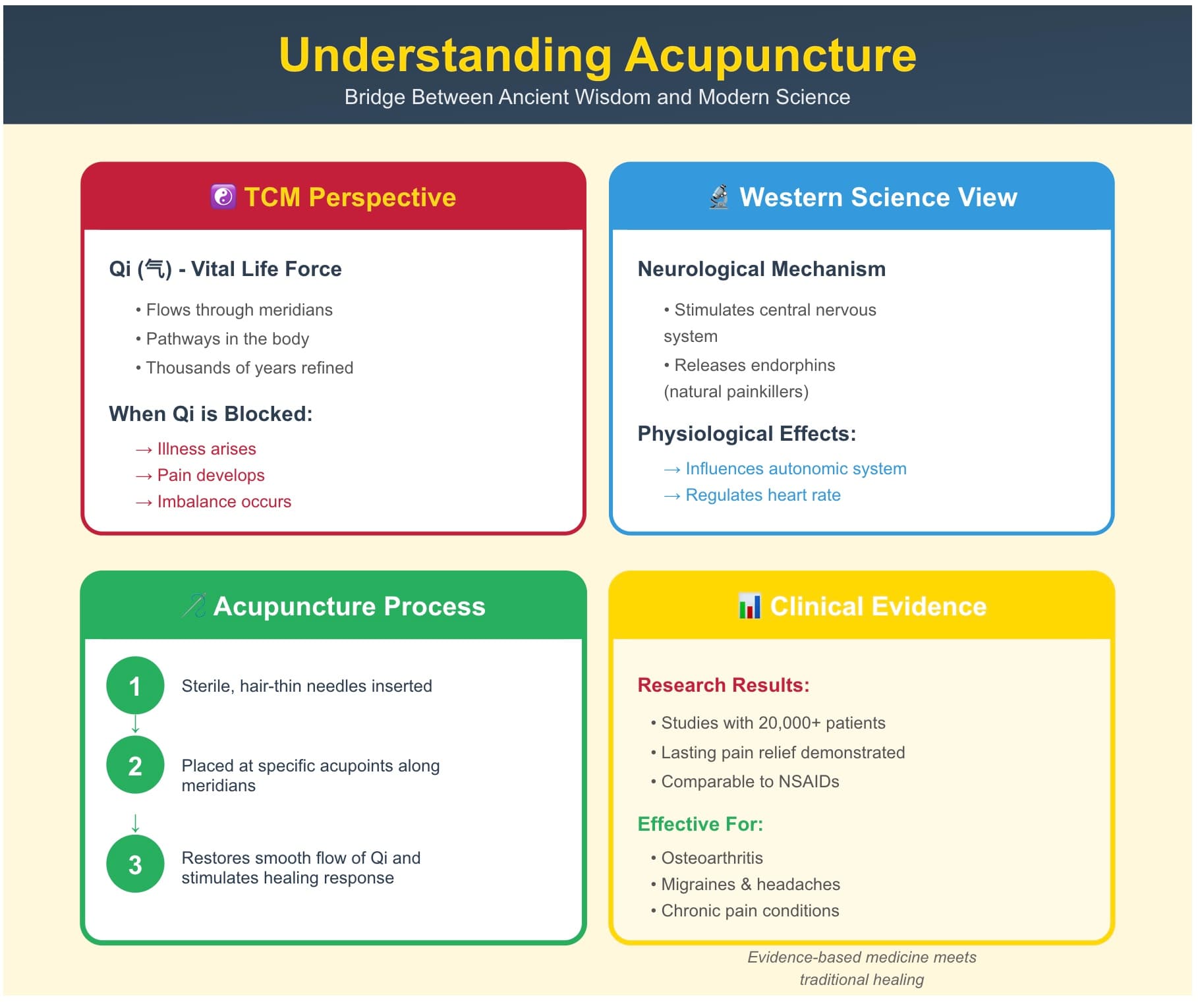
Acupuncture is a key component of TCM, a system of medicine that has been refined over thousands of years. The core principle lies in the concept of "Qi" (pronounced "chee"), the vital life force that flows through pathways in the body known as meridians. According to TCM, illness and pain arise when the flow of Qi is blocked or imbalanced. By inserting sterile, hair-thin needles into specific acupoints along these meridians, practitioners can restore the smooth flow of Qi, thereby promoting healing and alleviating symptoms.
From a Western medical perspective, acupuncture is believed to stimulate the central nervous system, prompting the release of endorphins, the body's natural painkillers. It can also influence the autonomic nervous system, which controls bodily functions like heart rate and digestion. Scientific studies have increasingly recognized acupuncture's effectiveness for a variety of conditions, bridging the gap between ancient tradition and modern evidence-based medicine.
The Wide-Ranging Benefits of Acupuncture
Acupuncture is sought for a multitude of health concerns, with benefits extending far beyond pain relief. It is renowned for its effectiveness in treating:
Chronic and Acute Pain: This includes back pain, neck pain, arthritis, headaches, and migraines.
Stress and Emotional Wellbeing: Acupuncture can be a powerful tool for managing anxiety, depression, and insomnia by calming the nervous system.
Digestive Health: It can help regulate digestive functions and alleviate symptoms of conditions like Irritable Bowel Syndrome (IBS).
Improved Sleep Quality: By promoting relaxation, acupuncture can significantly improve sleep patterns.
Women's Health: It is often used to address menstrual issues, infertility, and symptoms of menopause.
Immune Support: Regular treatments can help bolster the body's natural defenses.
While generally very safe when performed by a qualified practitioner using sterile needles, potential side effects are minimal and may include soreness or minor bruising at the insertion sites.
The China Advantage: Why Travel for Acupuncture?
When you seek acupuncture treatment in China, you're learning from practitioners trained in the discipline's birthplace, where the lineage stretches back over 2,000 years through legendary physicians like Huangfu Mi, the "Father of Acupuncture" who lived in the 3rd century CE, and Li Shizhen, who compiled the monumental Compendium of Materia Medica in 1593 documenting 1,892 medicinal substances.
Chinese acupuncturists complete rigorous 5-year bachelor's degree programs at specialized TCM universities—substantially longer than most Western certification programs. China operates 42 mono-specialized TCM universities and 238 universities offering TCM programs, with 46 providing master's degrees and 17 offering doctoral programs. Institutions like Beijing University of Chinese Medicine, Shanghai University of Traditional Chinese Medicine, and Guangzhou University of Chinese Medicine combine academic excellence with intensive clinical practice at public hospitals treating hundreds of patients daily.
The depth of clinical experience available in China is unparalleled. At major TCM hospitals like Longhua Hospital in Shanghai, practitioners see 4.15 million outpatient visits annually. Guang'anmen Hospital in Beijing recorded 3.36 million outpatient visits in 2019. This volume of clinical exposure means practitioners develop pattern recognition and treatment refinement impossible to achieve in lower-volume settings. Students and resident physicians train alongside National TCM Masters—physicians recognized at the highest level for their clinical expertise and scholarly contributions.
Cost represents another dramatic advantage. A 2025 survey found average acupuncture costs in China of approximately 19-150 yuan per session (roughly $3-20 USD), compared to median costs of $80-112 per session in the United States, £50-120 in the UK ($65-155), and $54-73 AUD in Australia. For international medical tourists, this translates to 90-95% cost savings on per-session rates. Comprehensive medical tourism packages that include consultations, treatments, accommodation, and cultural experiences typically cost 12,000+ yuan ($1,650+)—less than a handful of sessions in many Western cities.
The integration of traditional and modern medicine in China creates unique therapeutic opportunities. At AAA-grade TCM hospitals, patients receive acupuncture alongside access to advanced diagnostic technologies, modern pharmaceuticals when needed, and integrative treatment protocols developed through decades of clinical research. Facilities like Xiyuan Hospital and Chengdu University of Traditional Chinese Medicine Hospital combine National Key Clinical Specialties in cardiovascular disease, oncology, and diabetes with cutting-edge research programs and international collaboration networks.
Reputable Medical Institutions for Acupuncture in China
Several hospitals in China are renowned for their TCM and acupuncture departments and welcome international patients.
In Beijing:
Beijing Hospital of Traditional Chinese Medicine: Established in 1956, this is a leading comprehensive TCM hospital with a dedicated international training center that has served thousands of individuals from around the world.
Guang'anmen Hospital, China Academy of Chinese Medical Sciences: A major TCM hospital with specialties in various diseases and a national center for TCM research.
Beijing United Family Hospital and Clinics: This international hospital has a TCM department with a bilingual team that integrates Western and Chinese medical practices.
In Shanghai:
Longhua Hospital Shanghai University of Traditional Chinese Medicine: One of the oldest and most respected TCM clinical centers in China, known for its outstanding patient care.
Shanghai East International Medical Center: This center offers acupuncture services with TCM doctors who can communicate in both Mandarin and English.
Shanghai United Family Hospital: With multiple locations, this hospital provides holistic healthcare, including TCM services, with experienced and well-trained specialists who offer care in English and Chinese.
In Guangzhou:
Guangdong Provincial Hospital of Traditional Chinese Medicine in Guangzhou ranks among China's oldest TCM hospitals, founded in 1933 and hailed as "the first in Nanyue Xinglin." With annual patient volumes that have topped the nation for over 20 consecutive years, this massive institution operates multiple campuses including facilities in Guangzhou and Zhuhai.